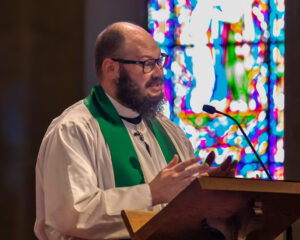
 Rev. Cn. Richard Hogue Jr.
With how crazy the world is right now and how messed up so many things seem, I wanted to take the lens of hope and Jesus’s hope for today’s readings. And I’ll start with Jeremiah. I know that the text from Jeremiah had a lot of crazy names. Thank you, Craig, for getting through those. It might seem like a boring story, but it’s not. There’s actually some good takeaways there when it comes to hope. So Jeremiah sets the scene. It is the 10th year of the reign of Zedekiah and the 18th year of Nebuchadnezzar. The date he is pointing us to and the time we’re fixing to in this is 588 BCE. The Babylonians have come to Jerusalem to lay siege on it and to put down a Jewish revolt. And Jeremiah knows what’s coming. Utter destruction, complete failure, hopelessness. And Jeremiah sits in prison because he spoke the truth. He foretold of the coming disaster saying that our ways have led to unfaithfulness. Our ways have led to idolatry. We haven’t been just to the poor and the meek. And so now disaster falls upon us. So he was imprisoned for that. We don’t know anything about losing something for telling the truth, do we, America? No. Nothing like that.
So Jeremiah sits here and yet an issue comes up where he can redeem his family’s land in a village not terribly far from Jerusalem. And from a prison cell, he chooses hope. He redeems his family property for 17 shekels. For what it’s worth, 50 shekels was what a man in that time, a Hebrew man would be charged for the temple tax for upkeep of the temple that’s about to be destroyed. So Jeremiah pays this relative pennies on the dollar, for lack of a better term, to redeem this land. Even though he has predicted the end, a brutal siege, and knows what’s coming, he chooses hope in the face of hopelessness. Imagine someone doing what Jeremiah has done in Ukraine, in Palestine, Gaza, in South Sudan. Imagine this in Taiwan, where there’s always the shadow of siege. It’s that kind of hope, hope in the face of hopelessness that Jesus chooses and chooses to give examples of for us.
The story of Lazarus and the rich man has a taste of that. The rich man, Jesus tells us in this story, wears nothing but purple. An incredibly expensive D. I’m not coming for the people in purple in the room, by the way, just to be clear right this second. But in that time, because of the process to make purple dye was so crazy hard, you had to have sea snails. It was a color reserved only for the emperor in Rome and later in Byzantium as well. and made of the finest cloth. This guy is, I guess the best way to put it is in our contemporary times, rocket ship rich. Okay, he is an Elon. He is a Larry Ellison. He is a Jeff Bezos. And he probably does not put his pants on the same way as the rest of us. He eats sumptuously. He eats, drinks, and is merry every single day.
And at the gate lies Lazarus, a man who’s only known evil in his days. A man who sits there with sores waiting for a crumb to fall. And the dogs, I would need to say I love dogs, but in the ancient near east and still in much of the near east today, dogs are not a good thing. They are filthy. They live on the margins. They pick up the scraps of food. They’re kind of gross. The dogs come to lick this man in pity.
The only thing that this rich man and Lazarus share is death. They both die. But we’re told by Jesus that Lazarus is taken up to paradise, the underworld in this case. in order to be with Abraham and to be comforted. And what does it say about the rich man? He died and was buried. There’s a cold feel there. But in this underworld that Jesus is setting up, the rich man sees Lazarus perhaps for the first time in his life and he calls to Father Abraham and he makes what is on one hand a terribly humiliating ask but an also on another hand incredibly arrogant ask because he says, “Father Abraham, Send Lazarus to dip his finger into the water so that I can be relieved of my torment for a short time.” Even in death, this man considers Lazarus a servant, someone to be sent to him. And what does Abraham say? There are three requests, there are three denials. “No, my child, you had it all in life. But in death, Lazarus is comforted. Just as you knew only good things, he knew only bad things.” And Jesus through Abraham makes something clear to us, too. That whatever life is after death, somehow equality is involved in it.
But not only that, Abraham says, “There’s this huge gap between us. There’s no way Lazarus can reach you now. Things are different now.” So the rich man shifts his focus. “Well, Father Abraham, in that case, can you send Lazarus again? Can you send Lazarus to my brothers so that he can warn them?” And what does Abraham say? “They have Moses and all the prophets. They should listen.” But one last time, the rich man says, “But Father Abraham, if Lazarus would only appear from the dead before them, they would repent.”
And this is where it gets me. He knows they should repent. He knows what it was in life that Moses, the law, and the prophets all point to. They all point towards mercy. They all point towards caring. They all point towards sharing what you have and in delighting in community. So he kind of gives it up here by saying, well, if, if they see a miracle, they’ll surely change their ways. They’ll turn back towards mercifulness. They’ll turn away from ostentatious arrogance. They’ll turn and make a different choice. They can share, care, and be fair. But what does Abraham say? Do you think a miracle would really do it? That’s pretty much what he says. The answer is no.
“What is the hope in this?” you’re asking me because I did say we we’d talk about hope. We’re alive to make a different choice! Jesus tells this story like he does the good Samaritan, the Prodigal Son, like Mary speaks in the Magnificat of making changes to bring the high low and the low high, to truly live into a different choice, to repent of the ways of the world to turn around and then care share and be fair with the Lazaruses of the world. We have the time. The story is about the dead, yes, but it is meant for the living.
So, I saw Lazarus this week and I didn’t want to go. And I’ll tell you why. We had clergy conference this week, which is lovely, but really messes up my personal cycle. So, usually I write my sermons on Thursdays, but this week, Wednesday through Friday was clergy conference. And so, I said, “Okay, Monday. I’ll do it Monday.” Well, Monday came and Monday went and it threw some curve balls at me. And one of those was a random call to go to Scripts Mercy and to visit with somebody I’d never heard of, never seen of, didn’t know. And I thought, “Oh, in my frustration, I’m never going to get that sermon done.”
So, I go to the hospital anyway because that’s what we’re supposed to do. And I go and I go into the room and I find this person and I softly and gently ask, “Ma’am, is there anything I can do for you today? I’m from St. Paul’s Cathedral.” It took me a solid two minutes to realize she was completely non-verbal. So, I call the chaplain and I ask, “What is it that they would like for me to do?” And they said, “Provide spiritual guidance.” And I was like, “Well, she’s non-verbal, but okay.” So, I took that based on everything else I saw in the room to mean it was appropriate to anoint her. Many of you might know it as last rights. In the Episcopal Church, we call it ministration to the sick at the time of death. So I look deep in her eyes which were filled with this mix of hopelessness and also deep hope and I anoint her. I go through the little ritual with her. And at the end we just stared into each other’s eyes. She hiccupped a little bit. I cleaned her up and then I waited for her to fall asleep, and I walked away.
Lazarus is everywhere. There might be a Lazarus sitting next to you here in church. There’s certainly Lazarus out on a street corner. There is a Lazarus anywhere you turn in this seemingly hopeless world. What Jesus asks us to do is to live in hope, to choose hope in the face of that hopelessness just like Jeremiah did and just like Jesus calls us to.
And so if you’re sitting in here today wondering what is the choice I need to make? What are the Lazaruses in my life? You are in the right place. Friends, St. Paul’s wants to see Lazarus. St. Paul’s wants to touch Lazarus and to do things differently. This is a community that wants to live in hope. That chooses to live in hope despite everything else you hear and see on TV, on the news, what you read on your phone. Jesus is saying, “Stop doom scrolling. Go and seek Lazarus. Choose to follow me.” Choose to be with people who think likewise, who want to change, who are willing to repent and to go a different way. Choose that hope. And in choosing that hope, we can make a better world. We can show a better way. We can live a different reality than the rich man. May we all find our Lazarus. In the name of the Father and of the Son and of the Holy Spirit.