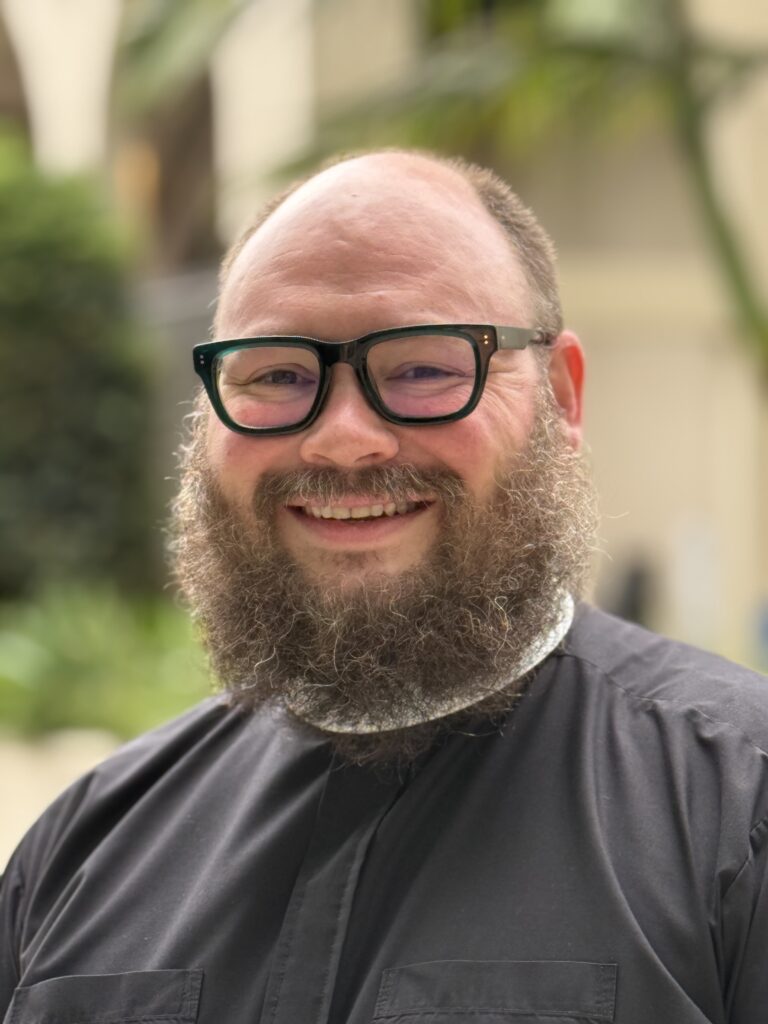
Rev. Cn. Richard Hogue Jr.
Today we begin a year long journey through the Gospel of Matthew in a three-year cycle of gospel readings, called the lectionary, that we share with a variety of Christians. Matthew’s gospel is the most Jewish of the four, observing Jewish practice, referencing Hebrew scriptures, their interpretation, and in structure. Like the five books of Moses, the Torah, Matthew is structured into five major discourses. While the subjects of the Torah and Matthew’s five discourses don’t line up thematically, they continue a millennia’s long conversation about God’s intention for humanity, our falling short, God’s response to our falling short in Jesus, and how we respond to grace in Christ. Matthew’s Jesus is in constant conversation with Hebrew prophets, like Moses, Elijah, and today, Noah, re-examining what it means to live faithfully in light of God’s love and desire to be close to us. Matthew’s five overarching topics are the Sermon on the Mount, evangelism, Jesus’ parables, church organization, and eschatology.
The word “eschatology” means the theological study of the end of human history, the finale. Jesus, in this passage, references the prophet Noah and the flood, the end of what already was, and moves to the not yet, and the disappearance of people in agrarian and domestic settings. This is not disappearance like ICE raids, this is far more immediate and cosmic. “Keep awake therefore, for you do not know on what day your Lord is coming.” It is fair to ask: Why begin a new cycle with Matthew by reading something about the end of everything that’s scary?
The honest answer: It frames what it means to live in loving faithfulness like Jesus’, which is ultimately the same faithfulness he asks of us. The chapter of Matthew we read from today starts with Jesus exiting the Temple after spending most of the day preaching and teaching there. It is the exact same day Jesus’ entered Jerusalem, the day we celebrate as Palm Sunday, the beginning of the end of Jesus’ Earthly ministry. He’s become a pariah to religious and Roman imperial authorities. He exits the Temple, after having caused a ruckus, proclaiming aloud that the Temple will be destroyed. It was quite the day.
Jesus’ disciples follow him up the Mount of Olives, a spot where they could look over much of Jerusalem, and he speaks of the overturning of all the stones of Temple. The disciples ask him, “Tell us, when will this be, and what will be the sign of your coming and of the end of the age?” Instead of directly answering their question, he warns them of false Messiahs, tells them of signs and portents. In all of this, Jesus draws on the ancient prophets to provide his seeming non-answer to the disciples’ questions. And that’s where we catch up with them today:
“But about that day and hour no one knows… For as the days of Noah were… before the flood they were eating and drinking, marrying and giving in marriage, until the day Noah entered the ark, and they knew nothing until the flood came and swept them all away, so too will be the coming of the Son of Man. Then two will be in the field; one will be taken and one will be left. Two women will be grinding meal together; one will be taken and one will be left. Keep awake therefore, for you do not know on what day your Lord is coming. But understand this: if the owner of the house had known in what part of the night the thief was coming, he would have stayed awake and would not have let his house be broken into. Therefore you also must be ready, for the Son of Man is coming at an unexpected hour.”
It’s terrifying. Could you imagine if you looked down in this moment, at your phone or bulletin, and then looked back up, and half of the people around you were gone? The flood was horror enough, but then Jesus compares himself to a thief in the night, and it has been a stumbling block for many. My favorite theologian of the ancient church, Origen of Alexandria, read this allegorically, the house as a person’s body, the housemaster the soul, the doors and windows as eyes and other senses, the thief the devil or temptation. It makes me wonder what Jesus’ metaphor meant for him; as a thief, what would he take, or perhaps more cleverly, what might he leave behind? I like to think this is trickster Jesus showing himself, the one who thwarts death and upends the gates of hell itself, turns water into wine, and walks on water.
Whatever the case, Jesus’ message is clear: his coming won’t be some seamless event, there will be unfathomable disruption. It’s difficult to hear and contemplate in a world already in constant turmoil, between brutal wars, horrific shootings, the existential threats of climate change, resurgent fascism and targeting of vulnerable people, ICE raids, and all manner of economic and racial injustice, let alone our individual shortcomings and grief. But the prophets and Matthew in kind speak of our collective rejection of God’s hope for us and our twisted hatred of each other as our own handiwork. Humanity, for all our accomplishments, is still both Cain and Abel, offering our best in hope of blessing, yet contemptuous of our own kind by bloodshed and neglect.
Still, there is good news here: Jesus’ way, God’s way, is the upheaval and disruption of our ways. Indeed, for those with perceived power, economic, military, or otherwise, God’s order is a befuddlement precisely because it reveals the truth behind the illusion of control. For the Roman Empire and its vassal states, the ultimate control was wrought through the willingness to employ war, capital punishment, essentially death as the chief power to make examples of the unruly. The cross was, first and foremost, a threat: go against us and we will torture you for days in front of your friends, family, and neighbors, until your own body chooses to give up under unbearable strain and embarrassment. But that power is brittle at best, as the phenomenal Star Wars show Andor reminds us, the “need for control is so desperate because it is so unnatural. Tyranny requires constant effort. It breaks, it leaks.” The upheaval Jesus brings is terrifying for the powers that be in the world precisely because those are not part of God’s intention for us, where death reign is no more and we only live life abundantly.
People perceived the cross to be the end, but for Jesus it was only a beginning. Noah saw death encircle humanity in the watery void, but for Jesus, the disruption of the power of death itself is at hand. Rather than drowning the living, the dead rise in triumph over death, and the righteous join with God as the gates of hell are smashed. And that’s why we begin this cycle of readings for the next year looking to the end of all things: because for Jesus, in Jesus, the end is the beginning, the alpha is the omega, all things are made new, and the ways of the world are inverted. The first shall be last, and the last shall be first. Jesus’ final Earthly journey is just the beginning of the rest of each of our stories.
I wonder what it was like hearing these words of Jesus on the Mount of Olives, looking out over the Temple and holy city of Jerusalem. Were they at all prepared for what they would watch? Probably not. But the reason they stuck with Jesus in the midst of their unknowing is the same thing we can hang onto, the unshakeable truth: God loves us so much that Jesus will turn the world upside down, making the low people and places high and humbling the mighty, giving the world over to the meek and blessing the persecuted. We as the church watch to see how we can participate in that inbreaking and reorientation of God’s new creation.
As the light wanes and nights lengthen this season, Jesus calls us watch for signs of God in our lives. Will we live and watch faithfully together? Join us at St. Paul’s as we watch vigilantly for the new light. “For out of Zion shall go forth instruction, and the word of the Lord from Jerusalem. He shall judge between the nations, and shall arbitrate for many peoples; they shall beat their swords into ploughshares and their spears into pruning-hooks; nation shall not lift up sword against nation, neither shall they learn war any more. O house of Jacob, come, let us walk in the light of the Lord!” Our king and savior now draws near! Come let us adore him.