Fifth Sunday of Easter, Year A
Penelope Bridges
Alleluia. Christ is risen. The Lord is risen indeed. Alleluia.
Stephen, one of the first batch of Christian deacons, takes center stage at the start of our Scripture readings today. False witnesses have accused him of blasphemy after he has attracted crowds with his speaking and wondrous acts. The high priest asks him if the accusations are true. Stephen responds with a masterpiece of a sermon, encapsulating the whole story of faith from Abraham’s call to the building of the first Temple by King Solomon; then going on directly to condemn his listeners in the council of elders for being just as stiff-necked and disobedient as the Israelites in the wilderness ever were. He even accuses them indirectly of murdering Jesus. These words get him killed by stoning, like Jesus a victim of mob violence, and the first Christian martyr. And Luke writes that a young man named Saul witnessed the whole thing. That young man became a dedicated persecutor of Christians, until he received a vision of the risen Christ and turned his life around, after being renamed Paul.
The martyr and the witness. It’s worth noting that the same Greek word has both meanings in English. Stephen witnesses actively to Christ and is martyred. Saul witnesses the stoning and the verse following our passage says. “And Saul approved of their killing him.”
The Gospel takes us back to the upper room and the gathering of Jesus with his disciples, the night of his arrest. Jesus has shared the last supper with his friends; he has washed their feet as a model of how they should serve one another; he has hinted at the betrayal ahead; and now he’s about to offer his final teachings, but first he has to deal with the anxiety that his words about betrayal have raised. Simon Peter has asked him where he is going; Thomas and Philip now join the chorus. They are afraid; they don’t know what’s going to happen next. We can all relate to that kind of anxiety when there’s an unknown future or a big change ahead.
We often hear this passage at funerals, reflecting our bewilderment at the finality of death. Where do our loved ones go? Will they be with Jesus? Is heaven a real place? How can we know the way? We don’t know what lies beyond the grave. We cannot follow our loved ones. At times of loss we need reassurance that Jesus will take care of those who have gone behind the veil, that there is indeed a place prepared for them, that they aren’t just lost in a void. When our world is shaking, we need to know we can depend on God’s promises.
Jesus says let not your hearts be troubled. Well, that’s easier said than done. How can they not be troubled? He’s just told the disciples that he will be betrayed and that he is going away. And when we take his words for ourselves, whose heart isn’t troubled, when we look at what is happening in our world: war, injustice, prejudice, famine, homelessness, to name but a few. My heart is especially troubled today by the war with Iran, which seems unjustified and unnecessary; by the wholesale detention and deportation of individuals without regard for what laws they may or may not have broken; and by the proposed draconian cuts to this city’s non-profits and arts institutions. How about you? Is your heart troubled too? This is no small thing Jesus asks of us.
“Believe in God, believe also in me,” he says. I want to change the verb here. To believe feels to me like an intellectual exercise. I think Jesus is more interested in a movement of the heart, something more like trust. And trust is a valid alternative translation, used in some major English versions of the Gospel. So let’s talk about trust: trust in God; trust in Jesus: another challenging instruction. Many of us have trust issues, especially when it comes to authority figures. Yes? Anyone here have trust issues with authority? And with good reason. We have been let down, betrayed, lied to again and again by those we were trained to trust: the church has let us down, employers, parents, government at every level. To trust in human beings or institutions is to set ourselves up for disappointment. This is a hard thing Jesus is asking: hard enough for the disciples to trust in Jesus whom they know; even more so for us, to trust in someone we haven’t seen.
After all this time, all these words and miracles and teachings, the disciples still don’t get it. How can they not understand who Jesus is? He has told them over and over, I AM. What more proof do they need of God’s love for them? In this threshold moment, between the earthly ministry of Jesus and his Passion, the disciples don’t know what to think. They don’t know the way.
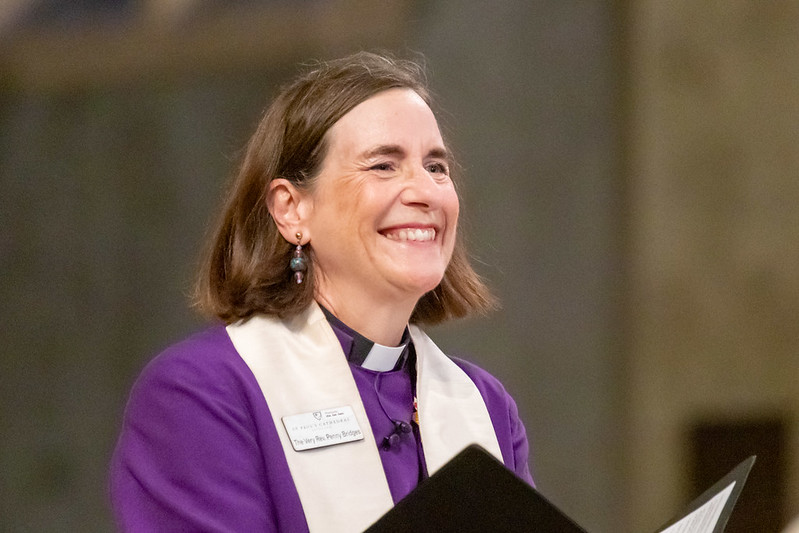
We don’t always know the way. We don’t know what joys and challenges lie ahead in our lives. But in baptism we promise, “I will with God’s help”. We take one step after another, trusting in God to guide our steps. When I accepted the call to serve St. Paul’s, over 12 years ago, I didn’t know anything much about southern California or San Diego. I didn’t know a whole lot about St. Paul’s. Somehow God gave me the grace to take the risky step, to move across the country, to commit myself to your service. I didn’t know what lay ahead. I didn’t know that we would be building and building and building. I didn’t know that we would be offering showers for unsheltered neighbors. I didn’t know that we would have to find our way through a pandemic. I didn’t know how fulfilling, challenging and just plain fun it would all turn out to be.
Now I face another set of unknowns, as you do too. Where will God lead St. Paul’s in the years ahead? What new things will you learn about God’s love and God’s mission in this place? This is a time to learn to trust in God, to trust that following Jesus is the way, to remember that we are, as St. Peter writes, a royal priesthood, called out of darkness into God’s marvelous light.
When life is tranquil and things are going well we are tempted to be self-reliant, to imagine that we have everything under control. But Jesus is still the way, the truth, and the life. Jesus is still Emmanuel, God with us. We can put our trust in him, the good shepherd, to lead us through the ups and downs. He is with us when we speak up like Stephen, when we witness to injustice, when we lament violence and persecution, when we tremble with fear for the safety of loved ones, when we struggle to understand people with very different world-views. He doesn’t insulate us from these challenges, but he does offer us a fullness of life that we won’t find without his leadership.
Jesus invites his disciples to follow him, to trust in him, to embrace a way of life that is centered on love. Understandably, they hesitate, they question, they prevaricate. And sometimes so do we, when we are called to do God’s work in the world. But Jesus has shown us the way: he IS the Way. He has told the truth: he IS the truth. And he has offered us life in his name, the life that he has laid down so that we might have life and have it abundantly. He IS the Life. Thomas asks, “How can we know the way?” Well, we know Jesus, and we know he is the Way. So let’s put our trust in God and commit ourselves to follow wherever Jesus leads us.
Alleluia. Christ is risen. The Lord is risen indeed. Alleluia.