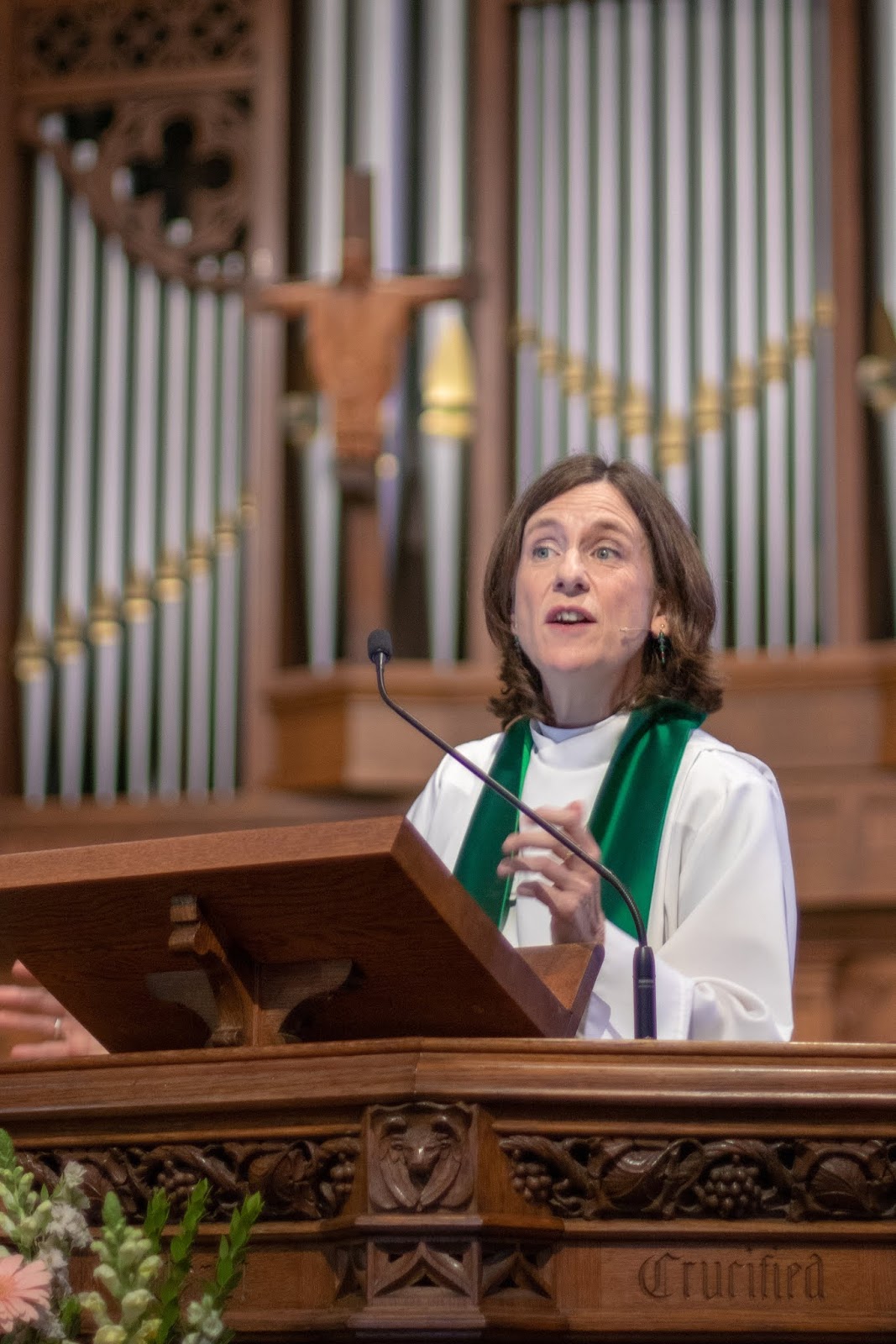
Dean Penelope Bridges
When we read Scripture passages in church on a Sunday morning, we read them in isolation from the rest of the story, and sometimes that means that we miss the full richness of the moment.
Today we find ourselves on a mountain top, first with Moses and then with Jesus and his closest friends. As impressive as these moments are, we shouldn’t lose sight of what else is going on, in the world down below.
Moses is called to approach God on the sacred mountain. This call comes as the people of God are getting into their stride, crossing the desert, after being miraculously rescued from their Egyptian slavemasters at the Red Sea. God has just laid out the requirements of the Law that will bind the people to their God, and the people have sworn to be faithful: “All the words that the Lord has spoken we will do.” Now God invites Moses and his secretary (and successor)
Joshua to climb up the mountain again, this time to receive the agreed-upon Law carved in stone, as well as a whole lot of other
instructions. They leave the priest Aaron in charge and they are gone for 40 days – just about the length of Lent, as it happens.
But at the end of the 40 days God says, more or less, “You’d better get back down there: YOUR people (YOUR people) have lost their tiny little minds.” When Moses and Joshua return to the camp, stone tablets in hand, they find that Aaron, no less, has led the people in an act of betrayal. It’s only taken 40 days for them to forget the
covenant they just swore to. They have taken the golden earrings that the Egyptians had given them and they have melted them down,
and created a golden calf, which they are now worshiping instead of the God who has led them into freedom. A lot can happen in 40 days.
In the Gospel, after traveling throughout Israel, healing and
teaching, Jesus has now turned his face towards Jerusalem. He has warned the disciples of the suffering that is to come, in the first of three predictions of his Passion. In Jerusalem, the conspiracy
against him is building, as the Pharisees and scribes seek a reason to take him down. Even as the disciples on the mountain come to recognize Jesus as the beloved and chosen of God, the people of God are once more plotting to betray the covenant.
So these two mountaintop revelations take place in the greater context of growing darkness. And that is often our experience too, isn’t it?
Mountaintop experiences are by definition fleeting moments.
Contrary to what Peter wants to do in the Gospel, it’s not possible to prolong them and dwell in them: at some point we have to come
down into the valley, to face the real world in all its brokenness.
This week we will follow Jesus into the wilderness of Lent, a time of self-examination and confession, a time of stripping away excesses, a time of austerity. We know that there is great darkness in the
world: so many people living in fear, so many who are hungry, so many who are in constant danger, so many who seem bent on
destroying the progress we have made in health, equality, and care of the planet. We need the bright presence of Jesus to guide us through these dark times, to remind us that, as little as we might feel we can do to help, each small effort lights a lamp for someone
floundering in darkness. Those who volunteer at the immigration court downtown, as a friendly and prayerful presence for the
terrified people attending hearings, tell me that it is a heartbreaking experience; and sometimes it’s hard to see that they are making any difference. But they are shining the light of God’s love on a very dark day, and they are making a difference for those families.
In the Hebrew Scriptures God is portrayed as being dangerous: to get too close to God is to risk death. In the Gospels, on the other
hand, God comes close to humankind in the person of Jesus. When the disciples are terrified by what they see and hear on the
mountaintop, Jesus touches them to reassure them and heal their fear. In Jesus we no longer need to fear God, because God is love
incarnate. The word the Gospel writer uses here for touch is used
elsewhere to mean to light up or ignite. The touch of Jesus changes things. It drives away darkness. It heals. And that touch can also ignite a fire in our souls, a fire of active love.
We can experience God’s healing touch in many ways. And the memory of a healing touch can transform an experience of darkness or pain: that’s why we often lay hands on someone when we pray for their healing. When I am particularly enraged by something I see in
the news, I close my eyes and recall the sensation of holding my sleeping granddaughter when she was just a few weeks old. That lovely baby weight on my chest, the sense of absolute peace and trust, the healing touch of love. I feel God very near to me in that moment of remembrance.
If we are paying attention, we will find many moments when the divine is revealed to us in the midst of ordinary life: small acts of
kindness, experiences of beauty in music or art, words of
encouragement or truth-telling. Lent is a good season to pay attention to God’s presence in our lives: to create opportunities to be quiet and still; to spend a little time journaling about the
moments of light that chase away the darkness; to shine the light of love on the people we encounter; to open our eyes to signs of God’s love so that we can better deal with the pain all around us.
Mountaintop experiences are rare and momentary, but we can hold onto them as memories that keep the darkness at bay. And we can witness to them, to ignite new life in those around us. That’s part of what we do on Ash Wednesday, when we go out across the city to offer loving presence, prayers, and blessings in places where people don’t expect them. We create little sparks of transfiguration for
hundreds of people, who might otherwise be living in darkness, transforming what might otherwise be a gloomy and hopeless day into a promise of new life.
The good news of the Transfiguration story is the good news of our Christian faith: that the all-powerful and transcendent God, who made the heavens and the earth, was willing to become one of us,
to reach out with a healing hand and word, to enter into the reality of this broken world, so that the light can shine in the darkest places.
That transfiguring light shines on us as we walk in the way of the Cross, empowering us to see the way forward, all the way to the bright light of Easter.