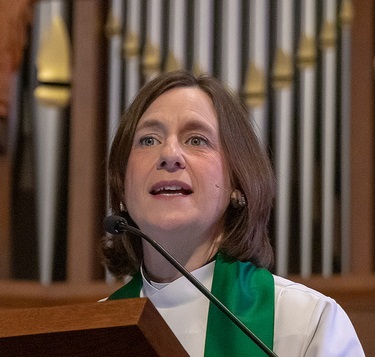
Penelope Bridges
Last month I attended a weeklong chamber music camp. I played my viola in small groups for 7-8 hours a day, bringing to life masterpieces of the classical and romantic eras. Chamber music usually requires that each part is played by one musician. You cannot rely on anyone else to fill in your gaps; you can see only your own part in the music; you have to know when to start playing and when to rest; you have to play in tune and in rhythm with the rest of the group. It is an extraordinary exercise for the brain, and it doesn’t allow room for thinking about anything else while you are playing. It can be stressful, but it is immensely satisfying when it goes well, each of us offering our own talent and energy for the good of the whole.
So I had this lovely experience of community life, and then returned to resume my ministry, and to continue the difficult calling of living faithfully and joyfully in the midst of global tragedy and injustice. And it is difficult, isn’t it? The question that is always before us is how to respond to the terrible things we see happening in the world; how and when to take a stand; how to resist being pulled into a maelstrom of depression and rage while remaining engaged and compassionate. And for those of us who speak from the pulpit, how to be true to our own convictions and speak truth about evil while offering hope and respite to our people who come here seeking safety and comfort
Hosea’s words in the Hebrew Scriptures have brought me face to face with the tragedy that is unfolding in Gaza. It’s uncanny how these ancient texts seem to reflect and comment on contemporary events.
Hosea gives us a tender and loving image of God as nurturing parent. It is an intimate picture, quite different from the frightening displays of power described elsewhere in the Hebrew scriptures. “When Israel was a child I loved him, and out of Egypt I called my son … for it was I who taught Ephraim to walk, I took them up in my arms … I led them with cords of human kindness, with bands of love … I bent down to them and fed them.” If you’ve ever loved a baby or small child, you will resonate with these words and you may see images of such tender moments in your mind’s eye.
This is beautiful: this is the God we worship, a God who bends down to the beloved and gently guides as a parent guides a toddler. This is what we want to see in Scripture. But Hosea doesn’t let us linger there, going on to state baldly how the beloved has betrayed this loving care. “The sword rages in their cities.” How can we read this and not think of missiles and machine guns aimed at hungry crowds and refugee shelters in those same cities?
Hosea’s lament rings true in our moment in history. The prophet says that God’s own beloved people have turned away from shalom and turned to violence. You may or may not call what is happening in Gaza genocide, but the evidence strongly suggests that Prime Minister Netanyahu is pursuing an intentional strategy of erasing Palestinians, whether Muslim or Christian, from their ancestral homeland through violent means.
How do we reconcile our experience of humankind as good with political decisions that result in the starvation of children and the destruction of hospitals, churches, and whole communities? What might God be saying right now about Gaza? How can God not weep as we weep at the emaciated bodies of babies, the descriptions of horrific injuries, the reports of the targeted murder of physicians and emergency workers, as well as the continued suffering of the hostages and their families.
And, lest we think we are off the hook in this part of the world; if we too regard ourselves as God’s beloved children, what might God be saying about the ending of US overseas aid, the indiscriminate rounding up and deportation of working folks, the epidemic of gun violence, the rejection of scientific research and vaccines, the dismissal of devoted and skilled public servants, the public discourse of insult, humiliation, and lies that seems to be all around us?
There is much to lament here at home, for those of us who believe in a way of sacrificial love, who strive for a world that reflects God’s beloved community. And what is worse, we feel impotent in the face of all this: what can one person, one church, one community do to change the situation? In fact, Hosea suggests, even God feels impotent in such a time, asking four times, “How can I?”, before concluding that only a divine roar will bring the recalcitrant child to heel. I pray for that roar to be heard.
But, despite the unfaithfulness, the violence, the idol worship, Hosea announces that God will not give way to anger. God continues to hope for reconciliation, for a turning back to love; for, as the prophet writes on the Lord’s behalf, “I am God and no mortal; the Holy One in your midst, and I will not come in wrath”. No matter how badly humanity behaves, God never gives up on us. God’s commitment to love outweighs God’s commitment to justice. Grace abounds in the midst of shameful betrayal. God shows us the way of love, and God shows us that we must not meet evil with evil.
Hosea paints a picture of a broken world, while the Gospel gives us a portrait of a deeply misguided individual; both passages are vivid depictions of our human potential for turning away from God.
In Luke’s parable the rich man talks to himself instead of asking God or consulting the law of Moses about what to do with his surplus wealth. He is entirely self-centered. There is no consideration of God or his neighbor. He imagines unlimited future security instead of living fully and generously into the now.
The parable invites us to ask, how does our generosity enable us to live for God and others rather than for ourselves? How does our wealth bless us and make the world better? As one of Paul’s letters states, “The love of money is a root of all kinds of evil”. And yet in our culture, extreme wealth is seen as a sign of success, whereas poverty is often seen as a character flaw.
The rich man in the parable proposes building a bigger barn to store all his surplus abundance. If your answer to having too much stuff is to rent a larger storage unit, I invite you to think about that for a moment. Do we really need all that stuff? Or does it threaten to get between us and God? If you read further in this chapter of Luke, Jesus goes on to say, don’t worry about your life because God will take care of you. I don’t believe he is recommending that we become destitute, but I think he is reminding us that material wealth shouldn’t be an end in itself.
As Paul says in the letter to the Colossians, “Set your minds on things that are above, not on things that are on earth”. As baptized Christians, everything we do is an extension of living out our faith: that’s what Paul means when he says “Your life is hidden with Christ in God.”
So, if you are wealthy, how will you use your wealth? How might you live fully in the now rather than anxiously worrying about the future? How might your wealth contribute to a better world? How might you live so that everything you do is consonant with your identity as a follower of Jesus, who gave all of himself for our sake?
Jesus offers us life in its fullness, a life free of anxiety, a life focused on the common good rather than on our own narrow interests. In a time when we see the world facing huge and apparently insoluble problems, the gift of life in Christ is more valuable than ever. We don’t have to ignore the horror of Gaza or the callous injustice of federal policies; in fact we must hold them up, lament them, and take whatever action we can to ameliorate them. But we can also live fully and joyfully into the life that God has given us. As the Psalm advises, “Whoever is wise will ponder these things, and consider well the mercies of the LORD”.