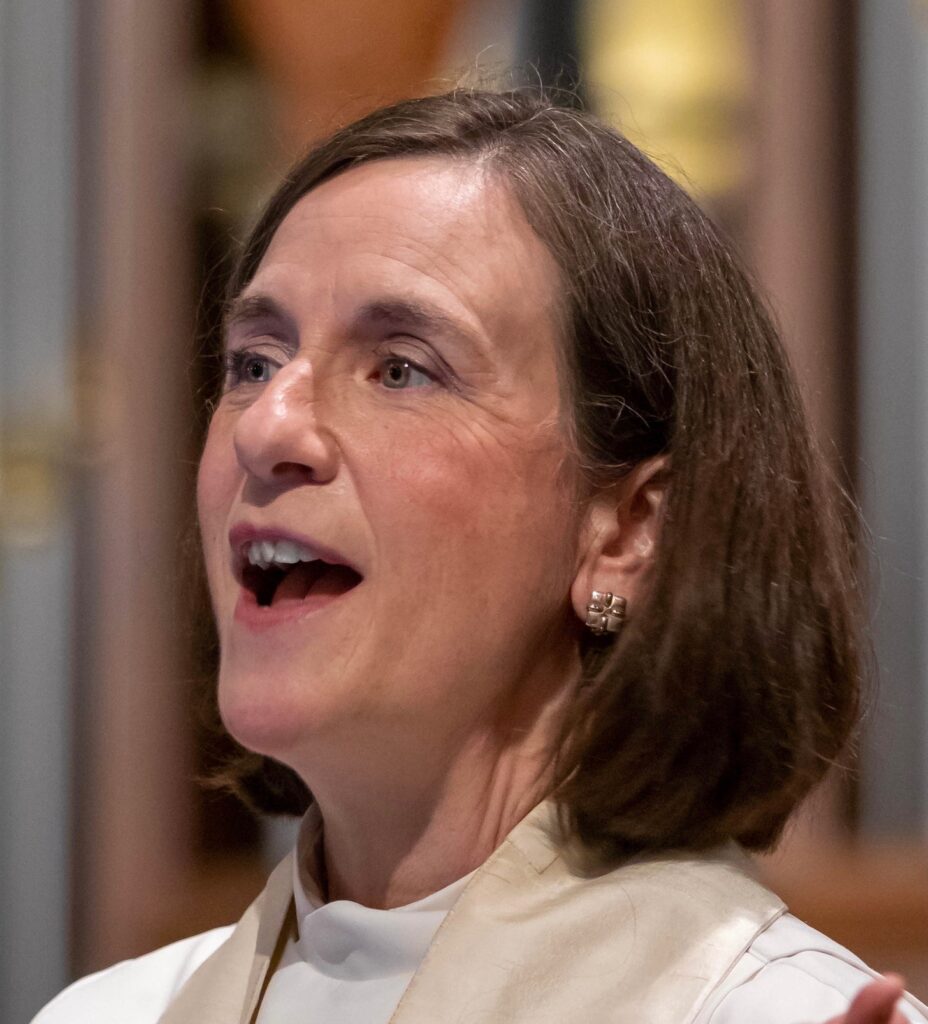
Penelope Bridges
Alleluia, Christ is risen! The Lord is risen indeed, Alleluia!
Today’s Gospel takes us back to Easter Day. Let’s imagine the scene:
A beautiful spring evening, a gentle twilight, life springing up all around. Birds twittering as they settle in the trees and bushes, lambs gamboling across the hillside, wood smoke and cooking aromas sneaking across their path. But Cleopas and his companion are sad, disheartened, too low in spirit to notice the beauty all around them. Have you ever been there? When you are heartbroken, the world can shrink as you focus inward. And these disciples are heartbroken. Because they have lost their hope. Their teacher, leader, and Savior has been cruelly killed, and they are facing once again a life of simply trying to survive an oppressive regime in a hostile world.
Luke describes them as disciples. Maybe they were in the upper room when Jesus first blessed, broke, and shared the bread. They are people of faith, prayerful people: they will have prayed before they set out from Jerusalem, as people of faith still do across the world today when they set out on a journey. They would have prayed for God to accompany them and protect them on the road. But they would not have expected God to show up in person. They were not in any shape to expect anything much, absorbed in their own grief and exhaustion.
The stranger catches up with them as they walk, and he hears what they are saying to each other. He asks about their conversation, and they are incredulous. How could this person not be aware of the drama that has just played out in the city? The palm procession, the turning over of tables, the crowds, the arrest and trial and execution? When we are in the midst of a personal disaster, it’s hard to imagine that anyone around us might be operating in a different context: surely, if my world is crumbling, you must be aware of it.
So they tell him. The two disciples must have heard many of Jesus’ teachings about Scripture, about raising up the lowly and giving justice to the poor. They pinned all their hopes – of liberation, of abundant life, of God’s promises fulfilled – on the man from Nazareth, who fed, healed, befriended, opening up a path of hope for so many who were downtrodden and discouraged. So, when he was cruelly and publicly put to death, it was a brutal blow. To have their hopes built up so high and then to have seen them dashed on the Cross: no wonder we hear their disappointment: “We had hoped that he was the one ….” They even mention the outlandish rumor that he has risen from the dead. And the stranger listens, and then he opens up the Scriptures for them, connecting with their sadness and rekindling hope in their hearts.
They reach their home in Emmaus and the stranger starts to walk on; but the two disciples are steeped in the ancient practice of hospitality and they invite him to stay: the roads are not safe at night, and inns are few and far between. Jesus accepts the invitation. He doesn’t assume that he can come in: he waits to be invited. Jesus never forces himself on anyone; but if you invite him, he will be there.
It wasn’t until the food was in front of them and he re-enacted what he had done in the upper room that their eyes were opened. And no sooner had they recognized him, than he was gone; his work of reviving hope and faith was done.
On Maundy Thursday, after the service, we enjoyed a wonderful soup supper, and thank you to all those who made the soups: I managed to taste about a dozen of them and they were all delicious. The blessings I said over the food come from ancient Jewish sources: “Blessed are you, O Lord our God, King of the universe. You bring forth bread from the earth; You create the fruit of the vine.” The prayers connect what we are eating with their source in Creation. How often do we forget to make that connection, as self-absorbed as we are? How much thought do we give to the cultivation, harvesting, transportation, and preparation of foodstuffs before they appear on the table?
When we are drowning in our own troubles it’s hard to be mindful of what is around us. And yet, it is when we pay attention to the natural world that we will find reasons to hope and to keep going. By offering the food with the traditional blessings, Jesus brought the two grieving disciples back to awareness of what was around them, including the presence of Jesus himself. In his own attention to the sacredness of food, he brought them back to mindfulness, to a place where they could know him and so be encouraged and empowered to share the good news.
On this Creation Care Sunday, we might think about how we can cultivate our own mindfulness of God’s creation. Because this is a lesson of discipleship.
Earlier this spring I walked by the mock orange bush outside my front door day after day, never really looking at it, although I always appreciate the blossom aroma. Until one day when I noticed a bee, and I stopped, and really looked at the bush. Every cluster of blossoms had a bee busily harvesting nectar. It was a little world of industry and purposeful action. And I had missed it all those days when I rushed past, thinking about other things.
Paying close attention to what is around us blesses us with greater appreciation of beauty and of the diversity of all life. It teaches us to pay close attention to other people: to notice how we are the same or different; to be curious, not judgmental; to appreciate each human being; to respect their dignity and find ways to seek and serve Christ in them. Learning to pay attention to Creation makes us better disciples, because in so learning, we also learn to recognize Jesus in the people around us, whether we are at church or at the auto mechanic; whether we are walking down the sidewalk or sitting in traffic. Paying attention leads to connection, and God knows we need more connection with each other in this world.
In the traditions of the Hebrides islands off Scotland, the people practice mindfulness in all their daily activities.
When a woman gets the fire going first thing in the morning she will say:” I will kindle my fire this morning in the presence of the holy angels of heaven.”
A harvest time prayer goes like this:” God bless thou thyself my reaping, each ridge, and plain, and field, each sickle curved, shapely, hard, each ear and handful in the sheaf.” Paying attention to every detail of what they are doing and dedicating it to God.
We don’t live in a rural, agricultural society. We are surrounded by mechanical and digital devices and systems. We are busy people. Are we too busy to pay attention in this way, to sanctify our daily activities with prayer?
In her book “Every earthly blessing”, Esther de Waal writes of the Hebridean traditions, “They were the prayers of people who are so busy from dawn to dusk, from dark to dark, that they have little time for long, formal prayers. Instead, throughout the day they do whatever has to be done care-fully, giving it their full attention, yet at the same time making it the occasion for prayer.” (Every Earthly Blessing p.4).
She comes to the conclusion that “the Celtic way of seeing the world is infused with the sense of the all-pervading presence of God. This is God’s world, a world to be claimed, affirmed, and honoured.” (ibid P.15)
She continues, “Here is a real opening up of the whole universe, to the birds and the animals no less than the sun, the moon and the stars, as well as to men and women. All become brothers and sisters, part of common creation.” (Ibid P.79)
In a world beset by war and division, our attentiveness to Creation can help us become people of peace, dedicated to love, eyes open to the beauty of what God has wrought and hearts open to the presence of Christ in all people. I’ll end with one of Mary Oliver’s shortest and most didactic poems, because it says it all in seven words:
Pay attention
Be astonished
Tell about it
(Instructions for Living a Life)
Alleluia, Christ is risen! The Lord is risen indeed, Alleluia!