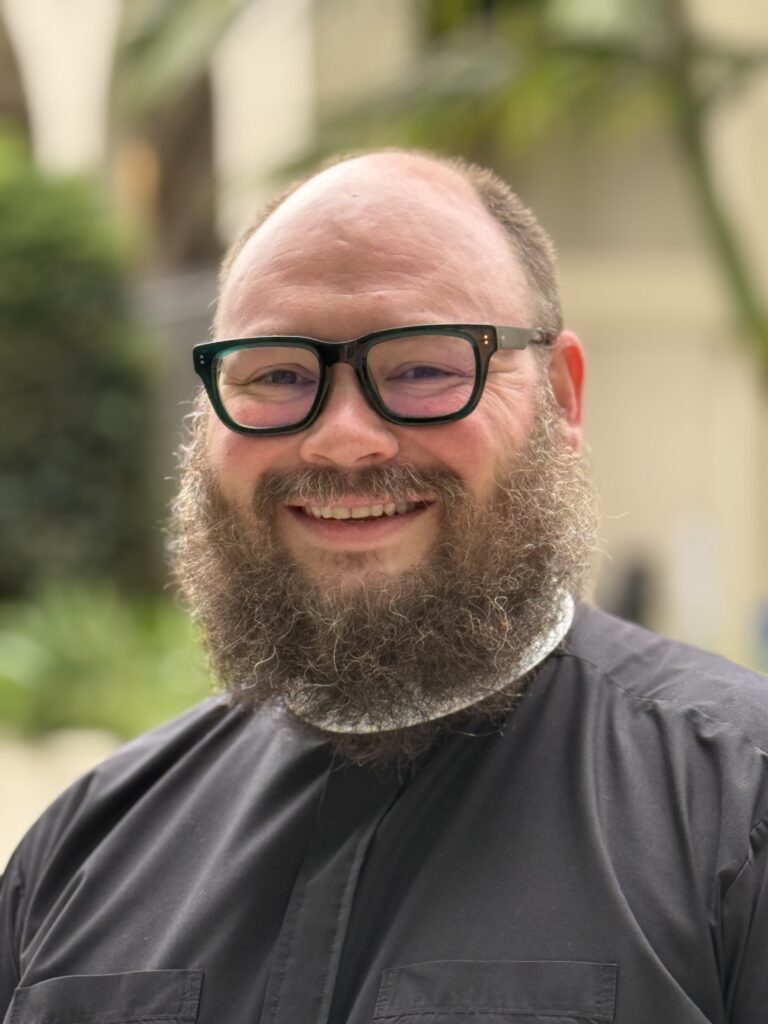
Rev. Cn. Richard Hogue Jr.
Recently, I realized that I’ve been a priest for ten years. The anniversary was actually back in September, but as a new twin dad, I didn’t exactly stop and celebrate. The same thing happened to my wife’s and my ten-year wedding anniversary in October. No Maui for us this time! You don’t always get what you want, but sometimes you get exactly what you need. My hands are quite literally full these days, and I couldn’t be happier.
As I was thinking about those anniversaries, I remembered another one. On All Saints Sunday in 2017, I got to do something I had been waiting more than a year to do as a priest. I got to baptize someone for the first time.
The funny thing is, it wasn’t supposed to happen that day. Just a few minutes before the service started, I was suddenly asked if I’d like to do one of the baptisms. I was caught completely off guard.
The joy and responsibility of holding someone else’s precious child was suddenly placed in my hands, and in my half-preparedness and enthusiasm, I said, “Yes!” It was a moment I had been waiting for, suddenly arriving.
And wasn’t it fortunate that I had just had my beard trimmed. Otherwise, that poor baby girl might have thought a face-hugging octopus was trying to drown her.
It was a good thing I was unwittingly prepared.
Preparation is one of the great themes of Scripture. Preparation often goes hand-in-hand with waiting. And if we’re honest, most of us spend a great deal of our lives somewhere between the two. Waiting and preparing. Or trying to, at least. We wait for healing. We wait for answers. We wait for reconciliation. We wait for justice. We wait for God.
And somewhere in all that waiting, we ask ourselves: What are we preparing for? How do we wait without becoming cynical? How do we wait without losing hope? How do we wait when the night seems longer than we expected? What does faithful preparation actually look like?
In light of all these anniversaries, I went back and read some of my reflections from a time I felt the weight of waiting and preparing. Before I ever began the formal process that led me to ordained ministry, I served as a missionary in South Africa. I lived in a town called Mthatha in the Eastern Cape, not far from where Nelson Mandela grew up.
My work was at a clinic located in a settlement called iTipini. In isiXhosa, the name means “the dump.” And that’s exactly what it was.
Let me paint the scene: About three thousand people lived on an abandoned garbage dump. Homes were built from discarded sheet metal, old lumber, scraps of plastic, bits of tarp, whatever people could find. The clinic served people living with HIV/AIDS, tuberculosis, injuries, chronic illnesses, malnutrition, and all kinds of medical needs.
When I first arrived, I still possessed the confidence that many young people have. I thought I might somehow help change the world.
That confidence didn’t survive very long. There were wounds that couldn’t heal. Incurable diseases. There were people who died despite everyone’s best efforts. There were problems far larger than any one person could solve.
After a while, I began to feel the weight of it all. Every day felt like one more small act against an overwhelming tide. And yet, I realize I was blind to something.
I thought I had gone there to help people. What I didn’t understand was that God had sent me there to learn from them.
Looking back now, what sustained me there was not certainty. It wasn’t success. It wasn’t the illusion that I was going to save the world. What sustained me was some small hope. And perhaps what Scripture calls Wisdom.
Our first reading gives us a fascinating image. Wisdom isn’t described as an idea, or a principle, or a rulebook.
Wisdom is a woman. Lady Wisdom. Sophia. And she isn’t hiding. She’s searching. “She is found by those who seek her.” “She hastens to make herself known.” “She graciously appears to them in their paths.”
I love that. We often think we’re supposed to go looking for God. And that’s true. But this passage suggests something else too.
Wisdom is already looking for us. She’s already ahead of us on the road. Already moving before we’ve even noticed.
And when I hear that, I think about iTipini. Because looking back, Wisdom was there long before I arrived. Not because poverty is holy. It isn’t. Disease is not holy. Suffering is not holy. But God’s presence is. And God’s presence among those people was unmistakable.
One of the things I learned there is that there’s a difference between power and wisdom. Power changes circumstances. Wisdom changes how we see.
When I first arrived, I thought I had something to offer. I imagined I’d be useful. Helpful. Maybe even transformative. Instead, I kept encountering forms of strength that I didn’t possess.
Part of my work involved driving patients to hospitals and other clinics in an old pickup truck. One day we brought a man to the hospital who was barely breathing. His eyes were closed. His body hardly moved. We waited for hours in an overcrowded emergency room. I tried to find help. I tried to make things happen. I tried to fix the situation.
Nothing worked. Eventually I found myself simply sitting beside him. Holding his hand. Waiting. I never learned what happened to him.
But I learned something. I had imagined serving there would mostly be about fixing things.
Solving problems. Producing outcomes.
I learned this: sometimes there is nothing to fix. Sometimes the holiest thing one can do is remain present. Sometimes wisdom looks less like having answers and more like refusing to abandon someone in their suffering.
And then there was another man. He had AIDS and was, frankly, one of the sickest people I had ever seen. The first time I met him, I quietly assumed he was dying. We practically had to carry him wherever he needed to go. His body seemed completely exhausted.
But he kept showing up. The next week he was there. Then the week after. Then the week after that. Slowly strength returned. Then a cane. Then a smile. Then gratitude shining in eyes that seemed increasingly alive.
What struck me wasn’t merely that he improved. It was that he had hope long before I did. I had already written his story. He hadn’t. His faith could see a horizon that I couldn’t yet see.
And maybe that’s what wisdom does. Wisdom teaches us that God’s future extends further than our imagination. Wisdom refuses to let present circumstances have the final word. Wisdom stands against despair.
The world would have looked at iTipini and seen nothing but failure. A garbage dump. Disease. Poverty. Forgotten people.
But Wisdom teaches us to see differently. The poor become teachers. The suffering become witnesses. The forgotten become bearers of hope.
And maybe that’s exactly what our reading means when it says that Wisdom “graciously appears to them in their paths.” Looking back now, I believe Lady Wisdom met me there.
Not in success. Not in triumph. Not in solving impossible problems.
I met her in learning to recognize God’s presence in people I might otherwise have overlooked.
And that brings us to today’s Gospel. The parable of the bridesmaids. I’ve always found it interesting that all ten of them fall asleep. Every one of them. Even the wise ones.
The wise bridesmaids don’t get extra credit for staying awake. They weren’t awake, they were asleep too. The difference is that when the moment came, they were ready. They had oil.
So what is the oil? For today, at least, I think the oil is what happens when a life is shaped by Wisdom.
Not simply knowledge. Not correct opinions. Not even good intentions.
Wisdom might be a way of living. Compassion practiced over years. Mercy exercised repeatedly. Faith strengthened through doubt or suffering. Perseverance when the night is long. Courage learned in hardship. The kind of things that become part of who we are.
No one else can give those things to us. No one else can live a life of faith for us.
The wise bridesmaids cannot hand over their oil because wisdom cannot be borrowed. Character cannot be borrowed. Faith cannot be borrowed. A life formed by God cannot be borrowed. It must be lived.
If Wisdom is one of the bridesmaids, she is the one, with lamp in hand and a spark in her eye, whispering to us all through the dark that this is only the beginning.
I believe that’s what I saw in iTipini. If I see myself in the parable, the oil for my lamp looked like people caring for one another despite having almost nothing.
It looked like a man whose body was failing him but who refused to surrender hope. It looked like neighbors sharing burdens because nobody survives alone.
It looked like people who had every reason to despair and yet continued to laugh, pray, sing, and dream.
Because that’s what wisdom looks like. Not certainty. Not control. Not guarantees. It is faithful endurance.
These days, with my twin boys at home, I rely constantly on faithful endurance. And like every parent, I find myself wondering what kind of world they’re growing up in. What the church will be like for them. What kind of people they’ll become.
I can’t control most of that. None of us can. But maybe that’s exactly what these readings are trying to teach us.
Faithfulness isn’t about controlling the future. It’s about tending the lamp we’ve been given. Seeking Wisdom. Practicing mercy. Learning courage. Refusing despair. Living into a future with hope, trusting that God is at work even when we cannot yet see the end of the story.
That’s what the people of iTipini taught me. That’s what the wise bridesmaids understood. And that’s what Lady Wisdom is still teaching all of us. How to recognize God’s presence in unexpected places. How to keep a lamp burning through a long night. And how to trust that God’s future is always larger than our fears.
In the end, maybe that’s the difference between wisdom and foolishness. Not intelligence. Not success. Not certainty. But learning to recognize where God already is, and having enough oil in our lamps to follow when God calls to us in the dark.
Amen.