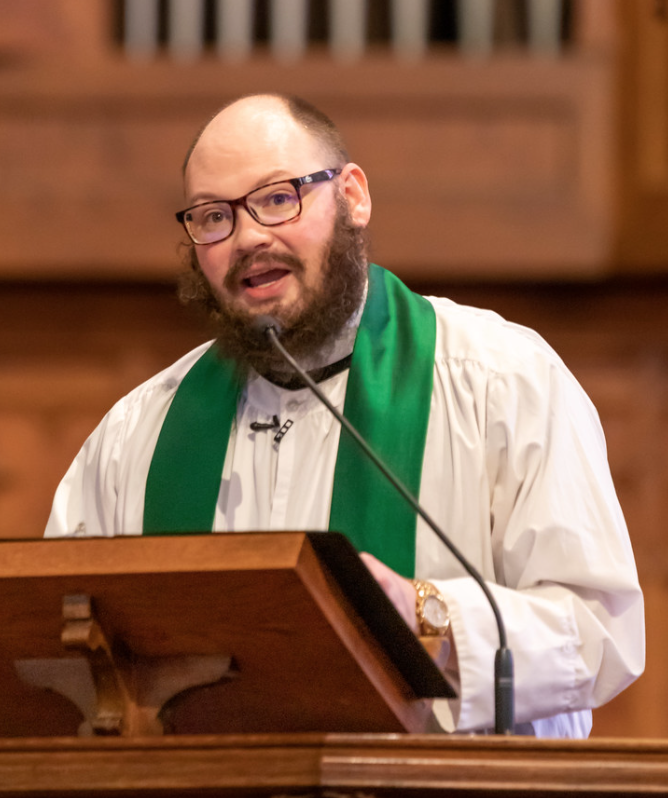
Rev. Richard Hogue Jr.
Happy Pentecost! I love the cacophony of the languages we heard earlier, representing the Spirit’s desire to speak to all people and their diversity in the church. I want to discuss one experience of Pentecost in my life in relation to today.
Nine years ago, I was one of forty some newly or soon to be ordained priests invited to Canterbury Cathedral from across the Anglican Communion. We were part of an annual program that the mother cathedral hosts aiming to increase relationship and dialogue across the global Anglican Communion.
I loved it. Beyond experiencing cathedral life for the first time, from matins to evensong daily, I enjoyed listening to siblings from India, Australia, East Asia, Oceania, and Sub-Saharan Africa. A friend I made in Hong Kong was there; I had gone to Hong Kong the year before to study their Anglican churches while in seminary. The South African’s who attended served as an interesting touch point for me since I lived in the Eastern Cape as an Episcopal missionary in 2009-10. It felt so whole to me.
This feeling of expensiveness was also a challenge, as diversity brings its own challenges. I remember speaking about human sexuality with a brother from Zimbabwe and his incredulity at our Episcopal stance queerness. Likewise, I was stymied when he explained bride prices were still part of the traditions encouraged by the Anglican Church in Zimbabwe. Diversity does not necessarily lend itself to unity, and yet we were there having these conversations. The differences, the conversations, the camaraderie were symbols of the whirling Holy Spirit, bringing people together across boundaries through the gift of Pentecost, acknowledging difference, but holding our various truths in tension. Not everyone there at the first Pentecost agreed on anything, as I am sure is the case in this room now. We ended our two weeks at Canterbury on the Sunday of Pentecost.
What I remember most that Pentecost was the Dean’s sermon. I must give a bit of a trigger warning as it was wrapped around a tragedy. You see, it was June 2017, the London Bridge attack happened while we were in Kent. We had been in that exact spot of the tragedy just days before on a visit to Lambeth Palace for tea with the Archbishop of Canterbury. We weren’t the victims, but we were shocked. Three assailants rammed a vehicle through pedestrians on that famous bridge, then got out on Borough High Street to begin killing more people. Eight lost their lives. Forty-eight more were injured. It could have been much worse. The metro police stopped the murderers, finding their bodies wrapped in explosives.
The Dean’s sermon telegraphed the feeling of many that morning, relating the moment to that first Pentecost. Jesus’ followers locked themselves in a room, fearing the torment of the religious authorities, or worse, execution by Romans. The people in Canterbury Cathedral in 2017 were afraid, much like our forebears in faith. It feels too close all these years removed, after the horrific violence perpetrated against our Muslim siblings at the Islamic Center of San Diego earlier this week. May Amin Abdullah, Mansour Kaziha, and Nadir Awad rest in peace and rise in glory, remembering their self-sacrifice, protecting innocent people and children. “No greater love is there than to lay one’s life down for another.”
While I can no longer remember the exact words of Dean Willis that morning in Canterbury, I remember the message: God can take any mess and bring about new life, even in the face of death. We proclaim it in our creeds; despite Jesus’ death, God creates new life where we might only see an ending. This doesn’t reduce or remove pain, frustration, anger, or righteous indignation at the world’s brutality. But we must channel our feelings to prayer, and prayer to action. God invites us to participate in changing this world. The Holy Spirit calls us to speak, just as the earliest disciples did, even if they were afraid. They were compelled to speak God’s truth.
As we heard in the Gospel this morning, Jesus said: “‘Peace be with you.’ After he said this, he showed them his hands and his side. Then the disciples rejoiced when they saw the Lord. Jesus said to them again, ‘Peace be with you. As the Father has sent me, so I send you.’ When he had said this, he breathed on them and said to them, ‘Receive the Holy Spirit.’”
“He showed them his hands and his side…” The truth is we are rightfully afraid of the terrible tragedies that can happen in this world, for good reason. Yet God has endured them, physically, mentally, emotionally. God confronts the wounds and terror of the world through Jesus confronted on the cross. The cross is the symbol of state sponsored terror, but God took its vile bloodlust and turned it into a symbol of renewal, the ultimate underdog story. Jesus, the backwater born and raised itinerant rabbi, upended the world forever. Pentecost is often referred to as the “birthday of the church,” and that’s appropriate. But I also think it’s the moment that the responsibility for upending the world as we know it shifts to us, the church, with tongues of fire, confusion, and all.
Where once people built the tower of Babel to reach the heights of heaven, on Pentecost, the heights of heaven rained down in fire to earth, opening tongues, ears, and hearts to God’s message that the world as we know it will never be the same again. What if, after leaving this place, we all were so joyous and loving that people become confused, thinking us drunkards as our love spills out into the streets? What if we lived such peace, such joy, such loving kindness, acting in the best interest of our neighbors, our enemies, and all people? What if we spoke the truth to the world with the Spirit’s fiery compassion? What if, after leaving this place, we organized and joined others in action, changing the status quo in the name of the Holy Spirit, the Advocate? What if our fiery compassion were so dangerous to societal complacency, hatefulness, and corruption, that we got noticed?
Whatever our answers to those questions, important as they are, there is a more fundamental truth Pentecost points to: God loves all people, all life, and wants us to love too. Not because life is perfect, not because of the way things are now, but because the possibilities of new life and love are so vulnerable yet waiting to grow. So, here we are this Pentecost, all gathered in one room, waiting for the Spirit to consume us. If you’re new to us, I hope you’ll join us at St. Paul’s. Together, we can live in love and care, making the world a more peaceful place, even if only in our beautiful corner of it. Who knows how far we can go with the Spirit’s wild wind at our backs. I hope God’s love and rejuvenating power will be heard around the world again, through us. “Peace be with you. As the Father has sent me, so I send you.”
Amen.